
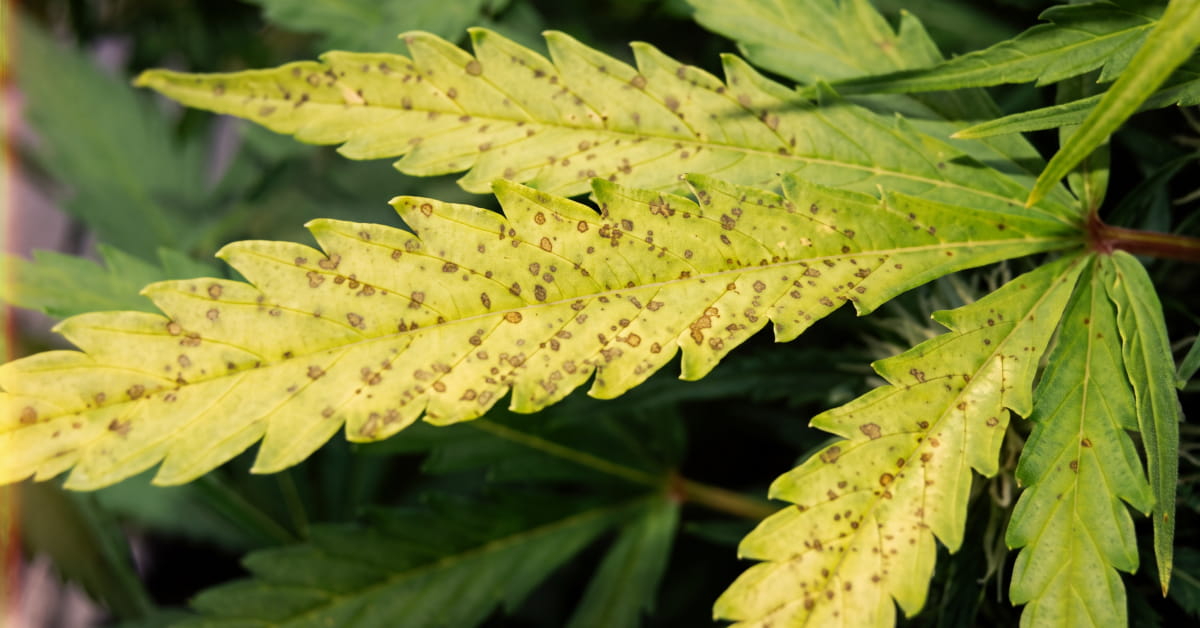
Cannabis manganese deficiency shows up as yellowing between the veins of new leaves, with small brown specks scattered through the yellow patches. It looks alarming, but it is one of the more fixable problems a grower runs into. In most cases, the plant is not short on manganese at all; the root zone has drifted too alkaline and locked the nutrient out.
This guide walks through how to identify manganese deficiency, why it happens, and how to correct it without guessing.
The short version: Those symptoms almost always mean pH lockout, not a real shortage of manganese. The root-zone pH has likely drifted out of range, usually too high (above roughly 6.3 in soil), so the plant cannot absorb the manganese it already has. Fix the pH first, and add manganese only if symptoms continue.
What Are the Symptoms of Cannabis Manganese Deficiency?
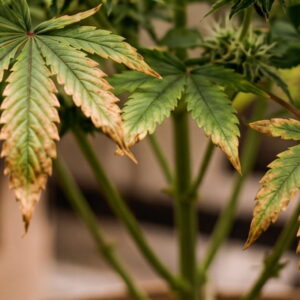
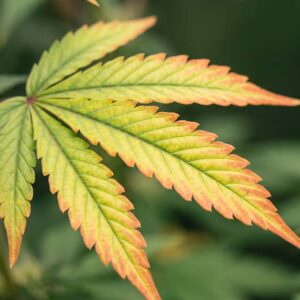
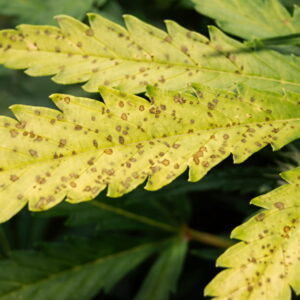
Cannabis manganese deficiency follows a recognizable progression on the leaf: the tissue between the veins pales to yellow while the veins hold their green, and small brown necrotic specks then surface inside those yellow zones.

That specking is the detail that sets it apart — the leaf takes on a mottled, patchy look rather than an even fade. As the shortage continues, those brown specks spread and can kill off sections of the leaf entirely.
Manganese also supports chlorophyll production and enzyme function, so a deficient plant slows its growth while the symptoms climb.
Location backs up that read. Plenty of deficiencies cause interveinal yellowing, but manganese concentrates its damage on the newest growth at the top of the plant, and left alone the flecks merge until the affected leaves turn brittle and drop.
Where Manganese Deficiency Appears on the Cannabis Plant
Manganese is immobile, so it moves poorly through the cannabis plant, which is why a deficiency lands on newer top growth first while the lower, older foliage often still looks fine.
This detail matters for diagnosis. If the yellowing starts on the old, lower leaves instead, the problem is more likely a mobile nutrient like nitrogen or magnesium, not manganese.
Manganese Deficiency vs. Iron, Zinc and Magnesium Deficiency
Manganese deficiency resembles iron and zinc deficiency, so the location and pattern of the yellowing separate them. All three micronutrient shortages hit new growth, which makes the brown specks and the exact pattern the deciding clues. The differences below can help growers distinguish manganese deficiency from iron and zinc deficiencies based on what they can actually see on the plant.
Manganese deficiency
- Where it starts: New or upper leaves
- Yellowing pattern: Interveinal, with the veins staying green
- Key sign: Brown necrotic specks in the yellow areas
- Usual cause: pH that is too high or excess iron
Iron deficiency
- Where it starts: New or upper leaves
- Yellowing pattern: Interveinal, with sharply defined green veins
- Key sign: Little or no specking in the early stages
- Usual cause: pH that is too high
Zinc deficiency
- Where it starts: New or upper leaves
- Yellowing pattern: Interveinal, often accompanied by shortened spacing between leaves
- Key sign: Twisted, small, or bunched new leaves
- Usual cause: pH that is too high or high phosphorus
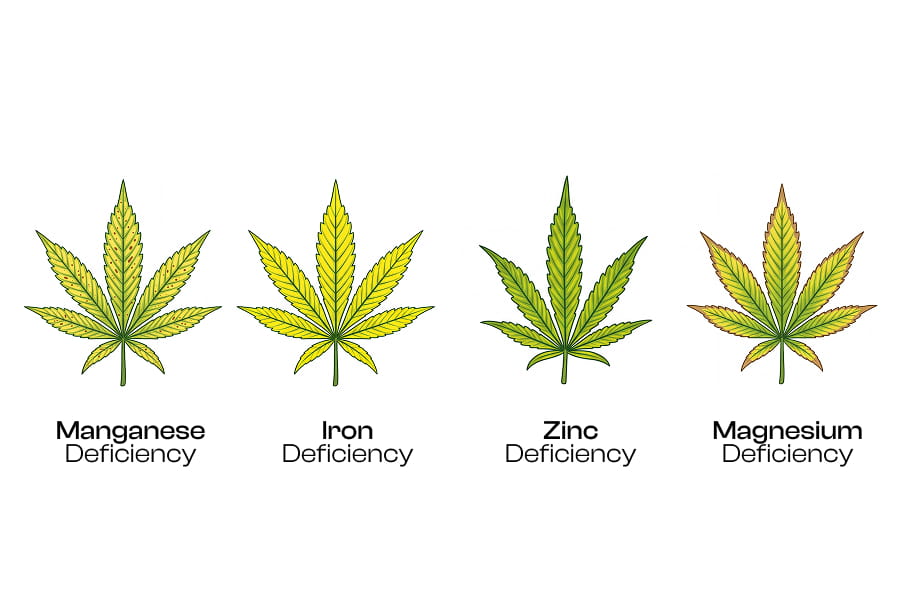
Use the pattern, not a single symptom. Iron deficiency looks similar to manganese deficiency but rarely shows early necrotic speckling, and zinc deficiency twists and shrinks new leaves in a way manganese does not.

What Causes Manganese Deficiency in Cannabis?
Manganese deficiency in cannabis usually traces back to pH lockout: most nutrient lines already carry enough manganese, so the plant is surrounded by the nutrient but unable to take it up. The second cause is a competing nutrient — usually iron — crowding manganese out at the root. Sorting out which one is at work decides how you correct it.
How pH Lockout Blocks Manganese Uptake in Cannabis
pH lockout blocks manganese uptake when the root-zone pH drifts outside the range where cannabis roots absorb manganese, most often by climbing too high. Manganese stays available in a fairly narrow pH band, and once the medium turns too alkaline, the nutrient becomes chemically unavailable even when it is present.
The plant then shows deficiency symptoms while the reservoir or soil still holds plenty of manganese. Correcting pH, not adding more feed, is what unlocks it.
How Excess Iron Triggers Manganese Deficiency
Excess iron competes with manganese at the root, so an overload of iron can push a cannabis plant into manganese deficiency. The two micronutrients share uptake pathways, and a heavy iron dose tilts the balance against manganese.
Growers who react to early yellowing by dumping in more micronutrients sometimes deepen the problem this way. Balance across the micronutrients matters more than the raw amount of any single one.
Download my free Grow Bible for more tips and read it while you grow your own marijuana.
How Do You Fix Manganese Deficiency in Cannabis?
To fix manganese deficiency in cannabis, correct the root-zone pH first, since that’s what unlocks the manganese already in the medium. Foliar feeding buys you fast relief while that takes hold, and re-feeding tops up anything genuinely used up. Match the step to the cause rather than doing everything at once:
- Reset the root zone — flush the medium only when an EC or TDS reading confirms salt buildup, then correct pH. If the medium is clean, skip the flush and only correct pH. This is what restores the plant’s ability to absorb manganese.
- Foliar feed for fast relief — delivers manganese straight to the leaves in acute cases, buying time while the root-zone fix takes hold.
- Re-feed only if needed — replace lost micronutrients with a balanced mix once uptake is working again, and top up manganese only if symptoms persist.
Reset the Root Zone to Restore Manganese Uptake
Test the runoff or reservoir first, and read two things off it: pH tells you whether the root zone has drifted, and EC (or TDS) tells you whether salts have built up. Treat both as drift signals, not numbers to chase.
If the EC is running well above what you fed in, flush with clean, pH-corrected water to clear the excess salts and iron. That handles the buildup. Correcting pH is a separate step that follows.
Bring pH into range according to your medium. In coco, hydro, or soil on synthetic nutrients, mix your feed and adjust that solution into the manganese band before watering (manganese locks out high, so usually that means bringing pH down, but confirm against your reading first).
In living, organic soil the microbes hold pH themselves, so a genuine high reading is eased down with a slow amendment like elemental sulfur, not by pH-ing the water. If the medium is clean and already in range, manganese isn’t locked out, so it’s a true shortage and you move straight to feeding.
In most soil grows this reset resolves the deficiency without extra nutrients, so give the plant a few days before judging whether more is needed.
Foliar Feed for Fast Manganese Correction
Foliar feeding delivers manganese directly to the leaves, which corrects an acute manganese deficiency faster than a root-zone fix alone. Mix a highly water-soluble manganese fertilizer or chelate and spray the affected foliage when the plant needs quick relief.
This buys time while the root-zone correction takes hold. Keep in mind that leaves already scarred by the deficiency will not turn green again, so watch the new growth to confirm recovery.
Re-Feed with a Balanced Micronutrient Mix
Re-feeding replaces the micronutrients the plant lost, but only after root-zone uptake is working again. Follow the reset with a complete nutrient solution that includes manganese: a hydro-grade micronutrient blend, a dedicated Fe-Zn-Mn product, or a manganese chelate all supply the nutrient in an available form.
Compost and greensand also carry manganese, though the plant takes it up more slowly. Hold off on heavy micronutrient dosing until the pH is stable, since piling nutrients onto a locked-out root zone only risks a new imbalance.
Not sure if your plants have a manganese deficiency?
Read the article Nutrient deficiencies in marijuana plants for a list with pictures of all deficiencies.
How to Prevent Manganese Deficiency in Cannabis
Manganese deficiency is easiest to prevent by catching pH drift before it ever reaches lockout, since the problem is far cheaper to avoid than to reverse.
Once it takes hold, the spread can run for up to a week after you correct the cause, and the scarred leaves never recover — so every leaf you keep healthy is one the fix can’t give back.
Regular pH checks and a consistent feeding routine catch the slow drift early, while it is still a quick adjustment rather than a rescue.
Target pH Ranges for Manganese in Soil, Coco and Hydro
Manganese stays available inside a fairly narrow, slightly acidic band, and holding pH there is the most reliable way to keep lockout from starting. The exact target depends on your medium.
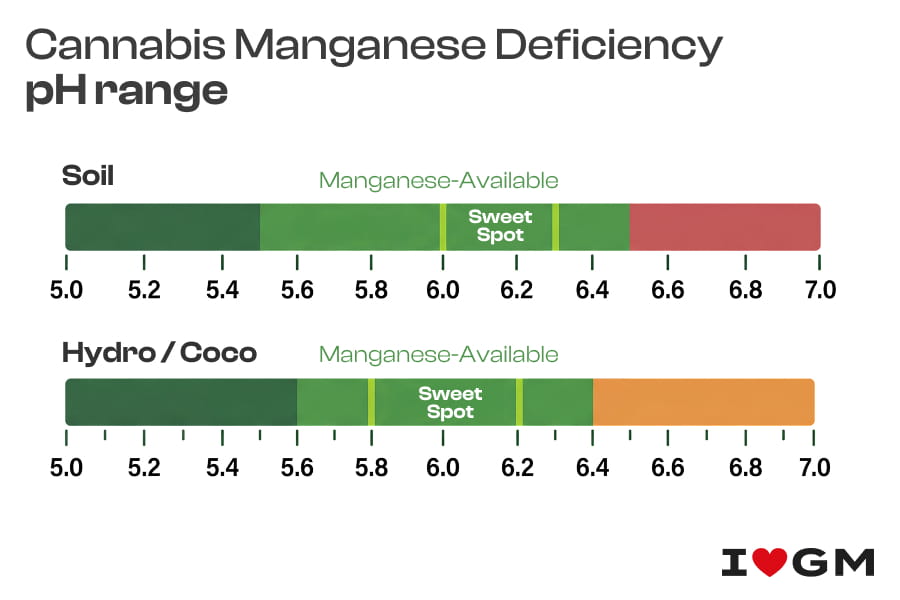
| Medium | Manganese-available pH range | Note |
| Soil | 5.5 to 6.5 (best around 6.0 to 6.3) | Push past 6.3 and manganese starts locking out, so treat the top of the band as a ceiling, not a target |
| Hydro / coco (soilless) | 5.6 to 6.4 (best around 5.8 to 6.2) | Manganese uptake stays strong right through the 5.8 to 6.2 sweet spot |
Check pH at every feed rather than trusting it to hold on its own. Fast cycles leave less room to recover from lockout, so a steady root zone matters most on quick-finishing plants.

ONE KIT, FULL GROW
- Full-cycle nutrition, no guesswork
- Sweeter, more flavorful buds at flower
- Matched formulas designed to work together
- Perfect for soil, coco, and soilless media
How Strong Genetics Help Prevent Manganese Deficiency
Manganese deficiency responds to pH and feeding fixes, but vigorous starting genetics give cannabis plants a stronger baseline to resist and recover from micronutrient stress. A plant with robust genetics puts out steadier new growth, which makes early symptoms easier to spot and quicker to reverse.
Growers who buy marijuana seeds from a reliable source start with that stronger baseline against pH swings and nutrient lockout. Genetics also shape how forgiving a plant is when conditions slip.
Growers who want an all-female crop without sexing and culling males often start with feminized marijuana seeds, which keeps attention on feeding and pH rather than plant-sex sorting. Growers who want a faster, lower-fuss harvest often reach for autoflower weed seeds, which flower on their own timeline without depending on a light-schedule change.
Matching seed type to your setup builds in a margin that makes the occasional pH slip easier to absorb.
Manganese Deficiency in Cannabis FAQ
What Does Manganese Deficiency Look Like in Cannabis?
Manganese deficiency looks like yellowing between the veins of new, upper leaves, with small brown necrotic specks inside the yellow patches while the veins stay green. As it worsens, the specks spread and the affected leaf tissue dies off.
Can Too Much Manganese Hurt Cannabis Plants?
Yes, too much manganese can hurt cannabis plants, mainly by interfering with iron uptake and triggering an iron shortage. Because manganese and iron compete at the root, overloading one throws the other out of balance, so aim for a balanced micronutrient supply rather than heavy dosing.
Is Manganese Deficiency the Same as Iron Deficiency?
No, manganese deficiency is not the same as iron deficiency, though they look similar on new growth. Manganese deficiency shows early brown necrotic specks inside the yellow zones, while iron deficiency usually shows clean interveinal yellowing with sharply green veins and little early specking.
How Long Does It Take a Cannabis Plant to Recover from Manganese Deficiency?
A cannabis plant can take up to a week to fully stop the deficiency from spreading after you correct the cause. Leaves already damaged by the shortage will not recover, so judge progress by the health of the new growth rather than the scarred older leaves.
Good diagnostic pictures and problem solving tips. I am a first time closet grower and had yellowing of some leaves. Turns out to be manganese deficiency.
I had to hold 2 Budda Kush in Veg for four months because there was no room . Anyways the 2 plant did good but I never got any smell even flowering no smell but frosty buds all over . Can you tell me what is going on thanks
Thank you so much really i can’t thank you enough✌
Have Amnesia Haze Autoflower, started over sixty days ago .Now shows signs of flowering .I am getting Tiger Bloom by Fox Farms .Is this the best product for this time in my grow cycle ?
Tumblecreekkid,
I am sorry mu friend. I cannot say that that is you r best option as tiger bloom is only 1 of 2-3 parts of the Fosfarm Trio system, used in the flowering stage. Join our friendly forum and learn what you need to be successful.
We have a mature knowledgeable membership. We are a happy forum. 🙂
[…] Manganese (or ‘’Mn’’, atomic number- 25 and atomic mass of approximately 55) is responsible for the production of enzymes and chlorophyll production vital for the photosynthesis. Its deficiency has various results which depend on the species. Cannabis plants’ chloroplasts become yellow and the stems are still quite green. On the surface of some leaves there may appear spots of white or grey. It also causes Iron- deficiency with similar symptoms to it. […]
joe b oio,
I had a hard time understanding exactly what you are asking. I believe that you would be best served by joining our Support Forum, where we have many experts and knowledgeable members will to guide you. Peace, lw
New to ge
Rowning this type of croup any advice on starting had good results withblac magic worm casing worm po lol gonna try nails for iron? A good top soil? Whats a good soilmix to start with? Findmyself peoblestart with?
Say what? what language do you speak fluently…use spell check friend… to grow is to communicate your needs clearly, then the wealth of information … cause you have questions will flow, like the weed you want to grow…. Cheers.
[…] especially when compare to the macronutrients. Micronutrients include zinc, copper, iron, boron, manganese, and molybdenum. A good option is the Marijuana Booster. A great product composed of the exact […]
[…] deficiencies are similar to manganese and iron deficiencies, accept that they influence new growth, causing them to become motionless. […]
[…] Manganese deficiency […]
I am using calmag and wondering how long to wait to see if it is working?i have a magnesium deficiency
Question… I have a plant that was vegging for first two months, than for a month I budded , now it’s vegging again.. Should I get rid of it or let it keep growing. Thank you
Have you checked your oh? Ph is always first priority even before nutrients. Having the proper ph when you flush is essential to helping the recover from lockout.
Can I use your booster nutrients in conjunction with Canna hydroponic nutrients?
I’ve been having a hell of a time with my nutes since I started my 2 months ago. I’m hoping someone on here might have some helpful info. I’m using coco with a flood and drain table. I went heavy with the nutes and locked them up but I did a good flush and stayed over with a new mixture but ever since then they just won’t grow. Like I said, 2 months and the tallest one is 6″. They are very pale green/yellowish and are now all of them are staying to get dead tips on the end of the leaves. I’ve done extensive research and can’t pinpoint the issue. Does anyone have any suggestions for me?
To hit back off the united
I gave my plants to much miracle grow they are starting to wilt what can I due