
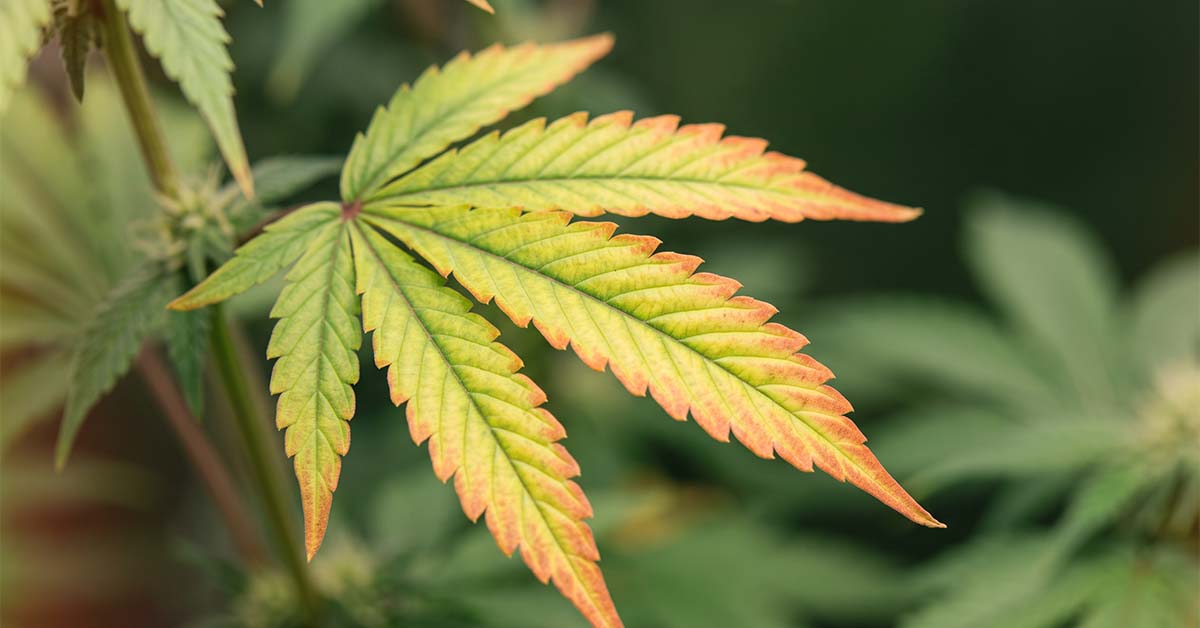
Cannabis molybdenum deficiency shows up as yellowing mid-plant leaves with a tell-tale orange, red or pink color creeping along the edges. It looks alarming, but it is one of the rarest deficiencies in cannabis, and it almost always traces back to root-zone pH rather than a missing nutrient.
This guide covers how to identify the deficiency, tell it apart from nitrogen, iron and copper problems, and correct it at the source. By the end, you will know how to read the leaves, fix the pH, and keep molybdenum available through harvest.
Straight to the point: the fix is almost always about pH, not feeding. Molybdenum locks out when the root zone turns too acidic, so bring pH back into range the right way for your medium, then re-feed a nutrient that includes molybdenum. Flush first only if salts have also built up. Catch it early and the new growth greens up within about a week.
What Is a Cannabis Molybdenum Deficiency?
A cannabis molybdenum deficiency occurs when the plant cannot access enough molybdenum to convert nitrates into usable proteins.
Molybdenum is a micronutrient, so plants need only trace amounts, but that small supply activates nitrate reductase, the enzyme that turns nitrogen into the building blocks for growth. When molybdenum runs short, nitrogen metabolism stalls and the plant starts showing stress even if every other nutrient is present.
True molybdenum shortages are uncommon. The mineral sits in most soils and nutrient mixes at low but steady levels, which is why it went unrecognized as an essential plant nutrient for so long.
In cannabis, the problem is usually access, not absence; the molybdenum is there, but the plant cannot pull it in through the roots.
What Are the Signs of Molybdenum Deficiency in Cannabis?
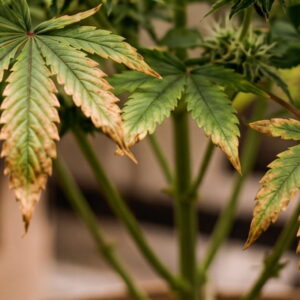
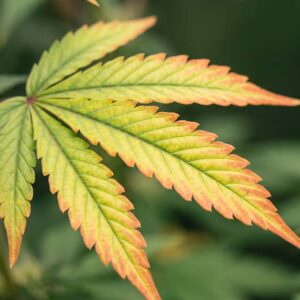
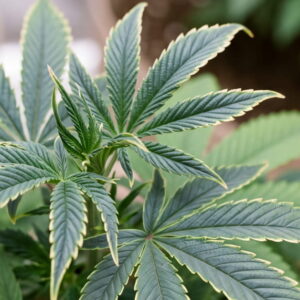
The deficiency announces itself first as yellowing on the middle leaves, before the orange, red or pink coloring works its way along the edges. Because the early yellowing mimics other problems, growers often misread it until those colored margins appear.
Molybdenum is a mobile nutrient, so once it flags mid-canopy the symptoms climb toward the newer growth as the shortage worsens. The three areas below sort the signal from the noise:
- Leaf appearance — what a deficient leaf actually looks like up close.
- Progression — how the symptoms move through the plant over time.
- Lookalikes — how to separate molybdenum from nitrogen, iron and copper issues.
What Do Molybdenum-Deficient Cannabis Leaves Look Like?
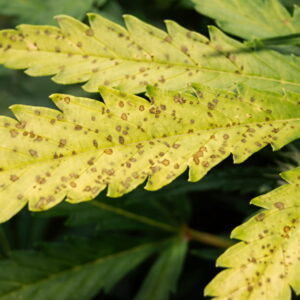
Molybdenum-deficient cannabis leaves display interveinal yellowing with orange-to-red or pink margins that migrate inward. The discoloration usually starts between the veins and along the edges of the mid-canopy leaves.
As the deficiency advances, dark brown mottled spots emerge inside the yellowing tissue, and the margins may curl upward.
How Does Molybdenum Deficiency Progress in Cannabis?
It starts on the middle leaves and works upward toward the new growth, with fresh leaves coming in distorted or twisted as it advances. If the cause goes uncorrected, the discoloration spreads, the margins curl, and tissue starts to die back.
Necrosis limits photosynthesis and leaves the plant open to secondary infection, and overall growth slows.
Once you correct the underlying cause, new symptoms stop appearing within about a week. The leaves already damaged will not turn green again, so judge recovery by the fresh growth rather than the old foliage.
Molybdenum Deficiency vs. Nitrogen, Iron and Copper Issues
Molybdenum deficiency differs from nitrogen deficiency mainly in where it starts and what color the leaves turn. Nitrogen shortage begins at the base of the plant with uniform pale-yellow leaves, while molybdenum starts mid-plant and adds the distinctive red or pink edge.
Molybdenum Deficiency
- Where it starts: Middle leaves, then moves upward
- Edge color: Orange, red, or pink margins
- Direction: Migrates upward to new growth
- Root cause: pH lockout, not an actual shortage
Nitrogen Deficiency
- Where it starts: Lowest, oldest leaves
- Edge color: Uniform pale yellow with no red edge
- Direction: Moves upward as nitrogen is remobilized
- Root cause: Actual shortage or nutrient lockout
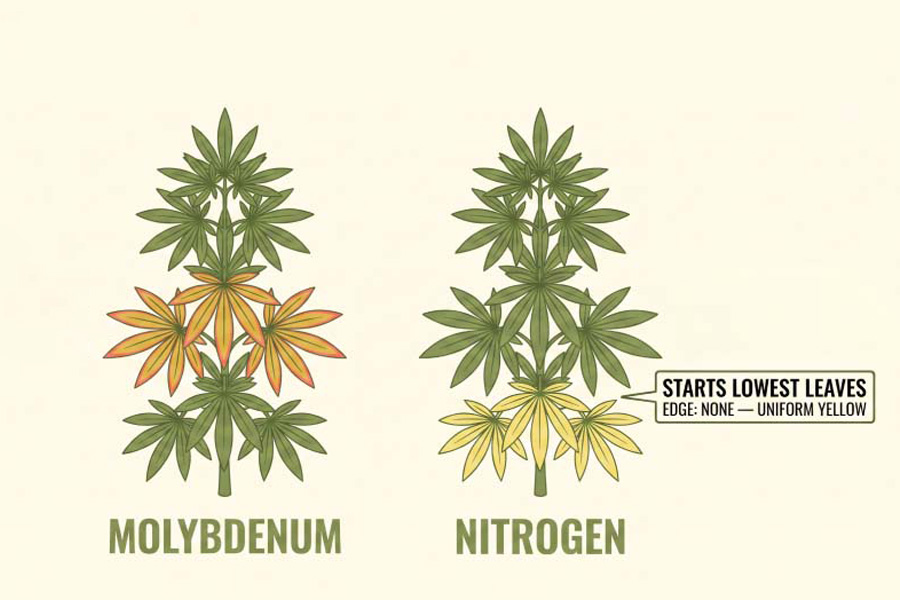
The red or pink edge is the single most reliable clue. Start location and progression support the diagnosis but do not confirm it alone, so weight the leaf color most heavily. When spots and yellowing point elsewhere, a nitrogen or manganese problem is the more likely culprit.

ONE KIT, FULL GROW
- Full-cycle nutrition, no guesswork
- Sweeter, more flavorful buds at flower
- Matched formulas designed to work together
- Perfect for soil, coco, and soilless media
What Causes Molybdenum Deficiency in Cannabis?
The problem is caused mainly by a low root-zone pH that locks the nutrient out, even when molybdenum is physically present in the medium. Molybdenum availability drops sharply once the root-zone pH falls below about 5.5, so an acidic root zone can starve a plant that is sitting in plenty of the mineral. This is why pH, not fertilizer, is almost always the first thing to check.
A few secondary factors can make matters worse. One is heavy sulfate feeding (think Epsom salts or gypsum), which competes with molybdenum at the root and can suppress uptake even when pH is fine. Another is cold growing conditions, which make the shortage more likely, especially in color-changing cultivars run on the cool side.
Compacted soil is the other culprit, because cramped, unhealthy roots absorb trace nutrients poorly regardless of how much molybdenum the medium holds.

How Do You Fix Molybdenum Deficiency in Cannabis?
You fix molybdenum deficiency in cannabis by raising the root-zone pH (it locks out in acidic conditions) and re-feeding a molybdenum-inclusive nutrient. If salts have also built up, clear them with a flush first, then correct pH on the clean baseline. That makes the repair mostly a matter of fixing the environment rather than piling on more nutrients.
Work through these three steps in order:
- Clear salt buildup — flush the medium with plain pH’d water first, but only if EC is high.
- Correct the pH and re-feed — raise pH into range, then feed a molybdenum-inclusive nutrient.
- Use a foliar spray — deliver molybdenum through the leaves for a faster assist.
Clear Salt Buildup First (If EC Is High)
Most molybdenum lockouts are pure pH issues and need no flush at all. But if a runoff EC or TDS reading comes back much higher than what you fed in, salts have built up too. You clear those by flushing before touching pH, not after.
Run plain water at your target pH through the medium (no nutrients added) until about one-third drains. This washes the salts clear and resets the root zone. With the buildup gone, move on to correcting pH on that clean baseline.
Correct the Root-Zone pH, Then Re-Feed
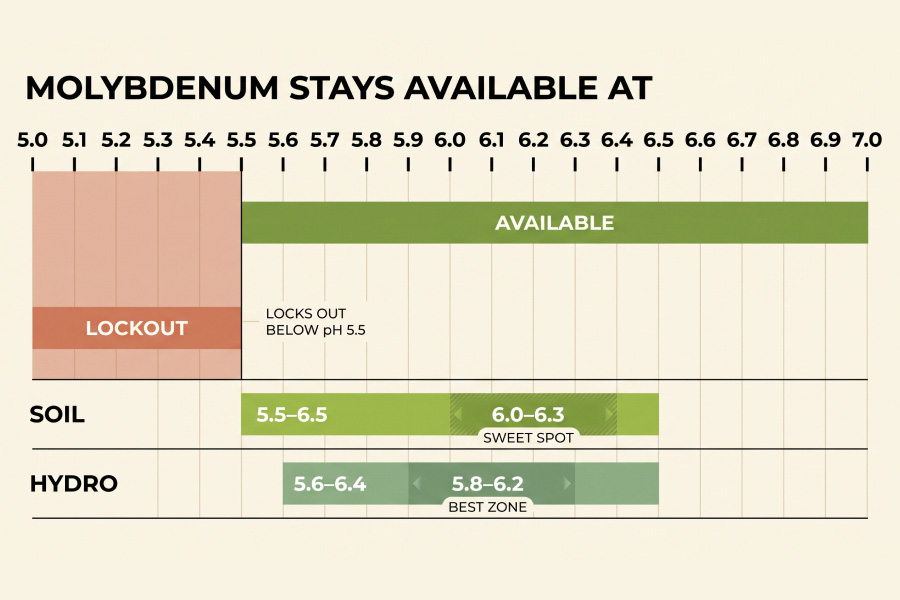
Molybdenum locks out in acidic conditions, so getting the root-zone pH back into range is what restores uptake. In soil, it stays available across a 5.5 to 6.5 range, with 6.0 to 6.3 the sweet spot. Pushing much past that trades a molybdenum problem for a wider one, since iron, manganese, zinc and copper all start locking out as the root zone creeps toward 6.7.
In coco or hydro, aim for 5.6 to 6.4 instead, holding it near 5.8 to 6.2 where uptake is strongest. Test the reservoir or runoff after watering (treating it as a warning light for drift rather than a number to chase).
Because molybdenum locks out when the root zone is too acidic, you are usually raising pH here. In living or organic soil the microbes hold pH themselves, so correct a genuinely low reading slowly with garden lime rather than pH-ing the water (it’s a temporary fix that doesn’t hold).
In coco, hydro, synthetic-fed soil, dissolve your nutrients into water and bring that mix up into the right pH range with a pH-up product before feeding. Once pH holds steady, re-feed with a balanced, molybdenum-inclusive nutrient so the mineral is available again.
Apply a Micronutrient Foliar Spray
A micronutrient foliar spray delivers molybdenum through the leaf stomata, bypassing a compromised root zone. Mix a molybdenum-inclusive micronutrient blend according to the product instructions and mist the foliage, which lets the plant take up the mineral while the pH correction takes hold below.
This works as a fast supporting move rather than a standalone cure, since the root-zone pH still needs fixing for a lasting result.
How Do You Prevent Molybdenum Deficiency in Cannabis?
Prevention comes down to two habits: staying on top of pH and keeping your micronutrients balanced. Checking your water runoff about once a week catches pH drift before it locks anything out, and the same weekly check protects against a nitrogen deficiency and a manganese deficiency, since both share the pH-lockout mechanism.
Balancing your trace nutrients matters just as much as pH. Going easy on heavy sulfate feeding keeps that competition from crowding molybdenum out at the root, and a balanced trace-nutrient routine keeps everything in check together. Watching for an iron deficiency still pays off, since molybdenum problems can read like iron ones in the leaf.
A steady, complete micronutrient supply also heads off a copper deficiency in the same feeding routine.
Keeping the root zone aerated and loose supports healthy roots that absorb all of these efficiently, so the whole trace-nutrient group stays available from seedling to harvest.
Strong Genetics Start With Healthy Cannabis Seeds
Healthy cannabis seeds give a grow its baseline vigor, which helps plants shrug off nutrient setbacks like a molybdenum lockout and bounce back once the pH is fixed. Vigorous genetics from quality marijuana seeds tend to root strongly and feed efficiently, and a strong root system is exactly what keeps trace nutrients like molybdenum flowing.
For growers who want a predictable, beginner-friendly start, feminized cannabis seeds produce female plants without the guesswork of sorting sexes. Growers on a shorter timeline often reach for autoflowering seeds, which move from seedling to harvest quickly without depending on a light-schedule change.
Cannabis Molybdenum Deficiency FAQ
Is Molybdenum Deficiency in Cannabis Common?
No, molybdenum deficiency is one of the rarest cannabis nutrient problems. The mineral is present in most soils and nutrient mixes at low, steady levels, so a genuine shortage is unusual. When symptoms do appear, a low root-zone pH locking the nutrient out is the far more likely cause.
Can a Molybdenum Deficiency Ruin My Harvest?
A molybdenum deficiency rarely ruins a harvest when caught early. Left uncorrected, it slows growth and kills leaf tissue, which cuts into photosynthesis and yield. Fixing the root-zone pH quickly stops the damage from spreading to new growth.
Do Damaged Leaves Recover After Fixing Molybdenum Deficiency?
No, leaves already damaged by a molybdenum deficiency will not turn green again. Recovery shows in the new growth, not the old foliage, usually within about a week of correcting the cause. Judge your progress by the fresh leaves at the top of the plant.
Does Molybdenum Deficiency Affect Autoflowers and Feminized Plants Differently?
Molybdenum deficiency works the same way across autoflower and feminized plants, since the cause is root-zone pH rather than seed type. Autoflowers move through their lifecycle faster, so catching pH drift early matters more when the window to recover is short. The fix stays identical regardless of the seeds you grow: raise pH, re-feed, and flush first only if salts have built up.
Thanks for reading. Please leave comments or questions below and don’t forget to download my free grow bible
Robert

[…] One of the main reasons molybdenum deficiencies are so uncommon in cannabis plants is the tiny amount required. Plants don’t require very much molybdenum. That also means that you should show restraint when treating a molybdenum deficiency. Growers often favor sprays and infused solutions to treat the plant. Read more about molybdenum deficiencies in marijuana plants […]
[…] Molybdenum deficiency […]
First shot and BAMM Baby.. Downloaded the Bible. Thanks alot. Peace love happiness and Best of Luck Growers.. Keep the planet Green and Clean Grow Marijuana Remember that the planet is’nt ours.. Its on Loan.. so lets do our part and keep it around for awhile.
i have tried to download the grow bible 9 times and
still nothing happens
I found a website that has only industry jobs in the u.s.a. I want to better my financialy, legaly campared to 3 years ago. I been on a clean streak since. I got your book but how can I prove myself as a grower to ulilize the highest paying position. Without a degree. I feel confident that I have your e-book. Plz let me know how to up my chances as a beginner pro. Than street level amateur. Thank your sir my deepest respect Do u also ship to AZ U.S.A.? Sincerely Juan V.