Passion Fruit is a sativa-leaning cannabis strain known for uplifting, giggly energy, a tropical citrus flavor, and very high THC from Dutch Passion genetics. It’s a favorite for daytime use, pairing motivating energy with a bright grapefruit-and-orange flavor that few fruity strains match.
This review covers its effects, genetics, cannabinoid and terpene profile, flavor, aroma, appearance, and grow traits.
What Is the Passion Fruit Strain?
Passion Fruit is a sativa-leaning cannabis strain bred by Dutch Passion, best known for its intense tropical-fruit character and its energetic, mood-lifting reputation.
The strain descends from a Sweet Pink Grapefruit clone crossed with Orange Bud, and that citrus-forward lineage shows up in almost every part of the experience. People reach for it when they want a bright, productive daytime session rather than a heavy sedative one.
The plant classifies as a near-balanced hybrid that leans sativa, so the head-focused lift arrives first and a gentle body ease follows. At a glance, Passion Fruit stands out for:
- Flavor — sweet, citrusy, and distinctly tropical
- Aroma — bright orange and berry
- Potency — very high THC from Dutch Passion genetics
- Pedigree — first prize outdoor at Copa Del Sol, Peru, 2018
Dutch Passion built the cultivar’s reputation on that combination of flavor and strength.
Passion Fruit is commonly produced as feminized seeds, with phenotype expression varying by breeder, grower experience, and growing environment. Browsing a wider catalog of marijuana seeds helps growers weigh their options across strains.
Passion Fruit Strain Quick Facts
Use this quick facts table to compare Passion Fruit by type, genetics, THC range, effects, flavor, terpenes, growing difficulty, and seed availability.
| Property | Value |
| Strain name | Passion Fruit |
| Type | Sativa-leaning hybrid |
| Ratio | Near 50/50, leans sativa (phenotype-dependent) |
| Genetics | Sweet Pink Grapefruit × Orange Bud (Dutch Passion) |
| THC range | Very high, around 20%+ |
| CBD range | 0.10% |
| Other cannabinoids | CBG 0.20%, CBC <0.05%, CBN <0.05% |
| Main effects | Uplifted, energetic, giggly, motivated, creative, focused |
| Flavor | Sweet citrus, grapefruit, with berry and apricot notes |
| Aroma | Sweet orange, zesty lemon, berry |
| Dominant terpenes | Beta-myrcene, alpha-pinene, terpinolene |
| Flowering time | 7–8 weeks indoors; mid-to-late autumn outdoors |
| Grow difficulty | Beginner-friendly — resilient and forgiving |
| Best environment | Warm, dry climates; indoor, outdoor, or greenhouse |
| Seed availability | Commonly available as feminized seeds |
Is Passion Fruit Indica or Sativa?
Passion Fruit is usually classified as a sativa-leaning hybrid. The genetics sit close to a 50/50 split, but the experience and plant behavior tilt toward the sativa side, which is why most sources describe it as sativa-dominant in feel.
Growers do occasionally find an indica-leaning phenotype, and that variation changes plant structure and training response more than it changes flavor or effect.
The sativa lean shows in how the high presents itself: a fast, heady lift that supports focus and conversation before any body relaxation settles in. That pattern makes it a stronger fit for daytime and early-afternoon use than for winding down at night. The plant itself grows tall and stretchy, another trait that tracks with its sativa side.
Classification can vary by breeder, phenotype, and source, so “sativa-leaning hybrid” works as a general guide rather than an exact prediction of effects.
Passion Fruit Genetics and Lineage
Passion Fruit descends from a Sweet Pink Grapefruit clone crossed with Orange Bud, developed and stabilized by Dutch Passion, the Amsterdam seed company established in 1987. The breeder received a friend’s Sweet Pink Grapefruit clone, saw its potential, and paired it with Orange Bud to lock in the citrus-heavy profile the cultivar is known for today.
The Sweet Pink Grapefruit side brings the tangy grapefruit sweetness and much of the sativa-leaning energy. Orange Bud, a long-standing Dutch Passion classic, adds the bright orange aroma, strong resin, and a forgiving grow pattern. Together the parents produce a plant that reads unmistakably tropical while staying resilient.
Phenotype variation is worth noting. Most Passion Fruit plants show the sativa-leaning structure and effect, but an indica-leaning phenotype can appear, growing shorter and bushier. This variation affects cultivation choices more than flavor or the high, both of which stay consistent.
Passion Fruit genetics influence what growers see in plant structure, flowering time, resilience, and aroma direction; cultivation outcomes and grow-from-seed expectations vary by phenotype, environment, and grower experience.
Passion Fruit THC Level and Cannabinoid Profile
Passion Fruit is listed by Dutch Passion with a THC level rated “very high,” testing around 20% and above, with exact potency depending on phenotype, grow conditions, harvest timing, curing, and testing source.
Some phenotypes have been reported in the 20–25% range, which places the cultivar firmly among the stronger fruity sativas rather than the mild ones. CBD sits very low at 0.10%, so this is a THC-forward strain with no meaningful CBD balance.
The minor cannabinoid picture stays modest. Dutch Passion reports CBG at 0.20% and both CBC and CBN below 0.05%, which is typical for a high-THC cultivar bred for potency and flavor rather than for a specialized cannabinoid ratio. The potency lives almost entirely in the THC.
Beginners or low-tolerance consumers should approach high-THC batches carefully because reported strength can vary between growers and samples.
| Cannabinoid | Range |
| THC | Very high, around 20%+ (some phenotypes reported 20–25%) |
| CBD | 0.10% |
| CBG | 0.20% |
| CBC | <0.05% |
| CBN | <0.05% |
Looking for marijuana seed deals? Subscribe to our seed deals to gain access to weekly deals on marijuana seeds!
What Are the Effects of Passion Fruit?
Passion Fruit is commonly reported to feel uplifting, energetic, and giggly, an experience usually described as bright, social, and productive rather than sedating. The onset arrives quickly, often within minutes of exhaling, landing first in the head as a clear, motivated lift that suits focus and creativity.
As the rush settles, a talkative, happy mood takes over, followed by a light body ease that relaxes without pinning anyone to the couch. Toward the end of a longer session, a mild sleepiness can creep in as the high winds down.
The energizing character makes it a better fit for daytime activity, conversation, or creative work than for a pre-sleep routine, and because the THC runs high, newer consumers should start small.
| Effect | Intensity | Notes |
| Uplifted | Strong | Fast heady lift, mood-brightening |
| Energetic | Strong | Supports focus and activity |
| Giggly | Medium | Social, talkative mood |
| Creative / focused | Medium | Suited to mental or physical tasks |
| Light body ease | Mild | Relaxing without couch-lock |
Passion Fruit Side Effects and Beginner Caution
Passion Fruit may cause dry mouth, dry eyes, and, in some users, dizziness or a brief anxious edge, especially for those new to high-THC cannabis. Because the onset is fast and the potency is very high, overindulging can bring on stronger reactions more readily than with a milder strain. The most commonly reported side effects include:
- Dry mouth and dry eyes — the most frequent and easily managed with water and eye drops
- Dizziness or headaches — more likely when consuming large amounts
- A brief anxious or paranoid edge — mainly in new or low-tolerance users
- Increased hunger — common, so keeping snacks nearby helps
As with many high-THC strains, low-tolerance users are the most likely to notice dry mouth, dry eyes, or discomfort. Experienced consumers tend to handle it more easily, but because the effects arrive fast, pacing intake is still the best way to keep the session enjoyable rather than overwhelming.
Starting slow and pacing intake is the reliable way to keep the session on the bright, energetic side rather than the overwhelmed side.

Passion Fruit Flavor and Aroma
Passion Fruit flavor is usually described as sweet grapefruit-citrus with berry and apricot notes, while the aroma carries bright orange and zesty lemon over a light berry sweetness.
The taste lives up to the name: many liken it to a passion fruit cocktail, balancing sweet and sour citrus with soft undertones of blueberry, apple, and grape. The smoke is smooth and refreshing, and the tropical sweetness lingers on the aftertaste.
On the nose, the strain announces itself before the first draw. Sweet orange leads, lifted by a sharp lemon zest and rounded out with a berry note, and breaking or grinding the buds sharpens the citrus further.
The aroma is inviting but far from subtle, which is worth keeping in mind for home growers. Compared with other fruity cultivars, Passion Fruit sits at the sweeter, more citrus-forward end rather than the gassy or earthy end — a clean, juice-like profile that has kept its reputation as one of the more flavorful sativas around.
Passion Fruit Terpenes
Passion Fruit’s terpene profile is commonly associated with beta-myrcene as the dominant terpene, supported by alpha-pinene, terpinolene, beta-pinene, and limonene.
Beta-myrcene leads the profile by a wide margin, anchoring the strain’s soft, earthy, slightly musky base note. Alpha-pinene comes next and adds a fresh, pine-like sharpness, while terpinolene contributes the fruity, floral lift that suits the cultivar’s sativa-leaning character.
The remaining supporting terpenes fill out the citrus and herbal edges of the profile. Beta-pinene reinforces the pine and woody notes, and limonene brings the bright lemon-citrus quality that ties directly to the strain’s orange-and-lemon aroma.
| Terpene | Aroma / Flavor | Prevalence |
| Beta-myrcene | Sweet, musky, soft fruit | Dominant |
| Alpha-pinene | Fresh pine, herbal | Supporting |
| Terpinolene | Fruity, floral, citrus-pine | Supporting |
| Beta-pinene | Pine, woody | Supporting |
| Limonene | Bright lemon citrus | Supporting |
What Does Passion Fruit Look Like?
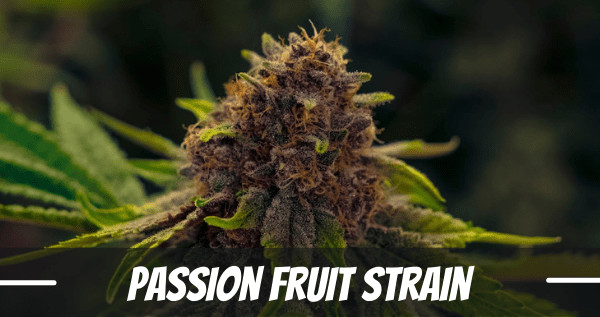
Passion Fruit buds are usually described as massive and dense, coated in a thick, sticky layer of trichomes that holds up well after harvest.
The flowers sit on a tall plant with thick stems and large, bright green fan-shaped leaves, giving the cultivar a robust, vigorous appearance in the garden. Burnt-orange pistils weave through the green, adding warm color contrast against the frosty resin coverage.
The overall look reads healthy and resinous rather than delicate. The heavy trichome coating gives the buds a frosted, glistening finish, and the density means the flowers feel weighty and solid. That combination of size, resin, and orange-pistil color is a large part of the strain’s visual appeal and a good indicator of the potency underneath.
Outdoor seeds that grow fast
- Easy to grow
- harsh weather-proof
- Can produce superior yields
- Fast growing marijuana seeds
Growing the Passion Fruit Strain
Passion Fruit grows as a beginner-friendly cultivar suited to warm, dry climates, reaching tall heights outdoors with a 7–8 week indoor flowering window. It is resilient and forgiving of mistakes, which makes it approachable for less experienced growers, and it responds well to a wide range of training techniques.
The plant prefers consistent temperatures and low humidity but adapts to less-than-ideal conditions with a bit more effort.
The cultivar shows solid resistance to mold and mildew, though tight, poorly ventilated indoor or greenhouse spaces can raise the risk, so airflow and moisture control matter. Yields tend to run above average for growers who give the plant room and light. Its aroma during flowering is strong and far from discreet, which is a practical consideration for home growers.
Passion Fruit responds to a wide range of training techniques, though growers working an indica-leaning phenotype should be cautious with methods that can damage the main cola. Techniques it takes well to include:
- Low-stress training (LST) and high-stress training (HST)
- Sea of Green (SOG) and Screen of Green (SCROG)
- Topping and super cropping
The plant’s tall, stretchy structure usually needs height management indoors.
How Passion Fruit grows from seed depends on the format — feminized, autoflower, or regular — with each suiting different setups, experience levels, and harvest goals..
Growing Passion Fruit Indoors
Passion Fruit grows indoors as a tall, stretchy plant that most growers keep to roughly 3 to 5 feet (1 to 1.5 m) with training, flowering in about 7 to 8 weeks.
The height and stretch mean most indoor growers rely on training to keep the canopy manageable, and the plant takes well to SOG, SCROG, and topping. As a photoperiod plant, Passion Fruit begins flowering when growers switch to a 12/12 light cycle, and a Sea of Green setup shortens veg time for a quicker turnaround.
Indoor yields tend to run above average when the plant gets adequate light and airflow. The strong flowering aroma makes odor control worth planning for in an enclosed space. Good ventilation also keeps mold risk low in the denser parts of the canopy.
Growing Passion Fruit Outdoors
Passion Fruit grows outdoors best in warm, dry climates, with harvest usually landing in mid-to-late autumn and mature heights reaching up to around 10 feet (3 m). The plant thrives with consistent temperatures and minimal humidity, though it is resilient enough to succeed in cooler settings with extra attention.
Its mold and mildew resistance helps in variable outdoor conditions, but growers should still watch moisture during late flowering. Outdoor yields are generous, and the plant’s vigor rewards a full season and open space to stretch.
Passion Fruit Seeds
Passion Fruit seeds let growers cultivate this cultivar from start to harvest, with seed type, pack size, and grow setup affecting plant behavior, flowering time, and yield. The strain is commonly available in feminized form, which suits growers who want flower-producing plants without sorting out males.
From seed, the plant’s tall, resilient structure and 7 to 8 week indoor flowering window make it a manageable choice for a range of experience levels.
Growers comparing formats often weigh feminized seeds against autoflower seeds based on how much control they want over flowering and timing. Growers should confirm lawful permission to germinate and cultivate seeds in their location before starting.
Passion Fruit vs Similar Strains
Compare Passion Fruit with similar strains if you want a different effect profile, flavor direction, potency level, genetic background, or growing behavior.
| Strain | Main Difference | Flavor | Potency | Choose This If |
| Orange Bud | Parent strain; simpler, milder profile | Sweet orange | Moderate | You want the Dutch Passion classic behind the cross |
| White Runtz | More even hybrid, candy-sweet | Sweet, fruity, creamy | Very high | You prefer a rounder, dessert-style profile |
| Grapefruit | Sharper citrus, less berry | Tangy grapefruit | High | You want pure citrus without the tropical berry blend |
| Tropical fruity sativas | Varies by cultivar | Tropical, sweet | Varies | You like the flavor family but want options |
FAQs About Passion Fruit Strain
What Is the Passion Fruit Strain?
Passion Fruit is a sativa-leaning cannabis strain bred by Dutch Passion from Sweet Pink Grapefruit and Orange Bud. It is known for a very high THC level, a sweet tropical-citrus flavor, and uplifting, energetic, giggly effects that suit daytime use.
Is Passion Fruit Indica or Sativa?
Passion Fruit is a sativa-leaning hybrid with a near 50/50 genetic split. Most plants express sativa-dominant effects and structure, though an indica-leaning phenotype occasionally appears. Classification can vary by breeder and phenotype, so treat it as a general guide.
How Strong Is Passion Fruit?
Passion Fruit is rated very high in THC by Dutch Passion, testing around 20% and above, with some phenotypes reported in the 20–25% range. CBD is very low at 0.10%. Beginners and low-tolerance users should start with a small amount because the potency and fast onset can feel intense.
What Are the Effects of Passion Fruit?
Passion Fruit is commonly reported to feel uplifting, energetic, and giggly, with a fast heady onset followed by a light, non-sedating body ease. Many users describe it as social, creative, and productive, which makes it better suited to daytime than to nighttime use.
What Does Passion Fruit Taste Like?
Passion Fruit tastes like sweet grapefruit-citrus with berry and apricot notes, often compared to a passion fruit cocktail. The flavor balances sweet and sour citrus with soft undertones of blueberry, apple, and grape, and it finishes smooth and refreshing.
What Does Passion Fruit Smell Like?
Passion Fruit smells of sweet orange and zesty lemon over a light berry sweetness, giving it a distinctly tropical aroma. The scent is bright and inviting but not subtle, and grinding the buds sharpens the citrus notes further.
What Are the Genetics of Passion Fruit?
Passion Fruit descends from a Sweet Pink Grapefruit clone crossed with Orange Bud, developed by Dutch Passion in Amsterdam. Sweet Pink Grapefruit contributes the tangy citrus and sativa energy, while Orange Bud adds the orange aroma, resin, and a resilient grow pattern.
What Terpenes Are in Passion Fruit?
Passion Fruit is dominated by beta-myrcene, supported by alpha-pinene, terpinolene, beta-pinene, and limonene. These terpenes map onto the strain’s sweet, piney, citrus aroma and flavor.
How Long Does Passion Fruit Take to Flower?
Passion Fruit usually flowers in 7–8 weeks indoors, with outdoor harvest in mid-to-late autumn; how long it takes from seed to harvest varies by seed type, setup, and phenotype.
Are Passion Fruit Seeds Available?
Passion Fruit seeds are commonly produced in feminized form, with pack sizes and stock varying by catalog source and current availability.