
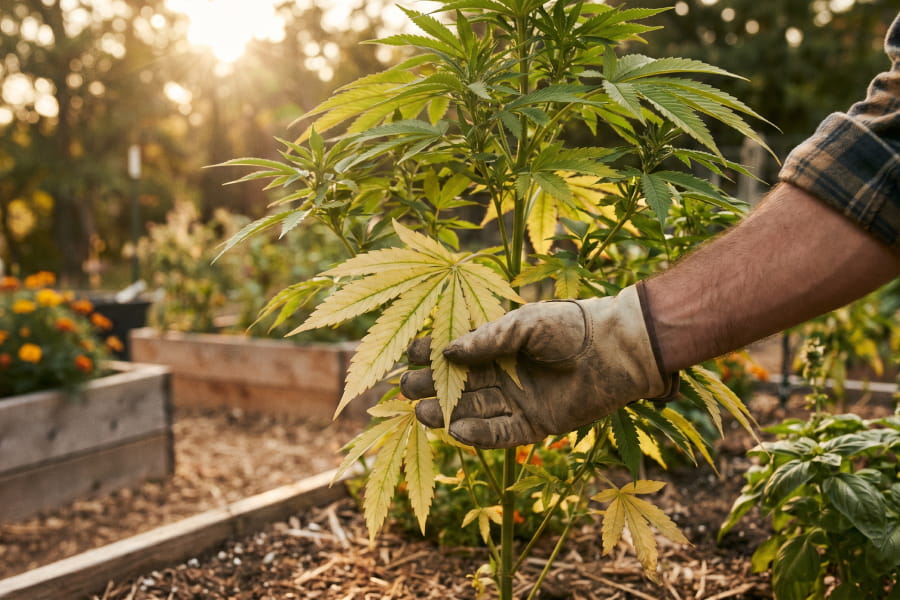
Cannabis nutrient deficiencies show up first on the leaves, and the leaf tells you most of what you need to know. A pale lower leaf, a scorched edge, a purple stem, or yellowing between the veins each points to a different missing element.
This guide reads those symptoms the way a grower does: start with what the leaf looks like, narrow it to the likely nutrient, confirm it against where the damage sits on the plant, then correct the cause.
Most deficiencies trace back to one of two things: a nutrient that isn’t there, or a root zone pH that locks out a nutrient that is. Both are fixable once you can name the problem.
Learn more about growing marijuana in my free Grow Bible.
What Are Cannabis Nutrient Deficiencies?
Cannabis nutrient deficiencies occur when a plant cannot access enough of a specific element to sustain healthy growth. The shortfall changes how leaves look, how fast the plant grows, and how well buds develop in flower.
A deficiency is not always a missing nutrient in the soil — it is a nutrient the plant cannot take up, which is why feeding more sometimes makes the problem worse rather than better.
Plants need roughly seventeen elements to grow. Growers group the ones that matter most into macronutrients (nitrogen, phosphorus, potassium), secondary nutrients (calcium, magnesium, sulfur), and micronutrients (iron, manganese, zinc, and a handful of others used in tiny amounts).
A deficiency in any one of them produces its own leaf signature, and reading those signatures is a core part of growing weed successfully from seed to harvest.
How Do You Read a Cannabis Nutrient Deficiency Chart?
A cannabis nutrient deficiency chart maps a visible leaf symptom to its most likely nutrient cause. You read it by matching three things: the color change, the part of the leaf affected, and the leaf’s position on the plant.
The table below pairs each common symptom with its usual cause so you can narrow the field before confirming.
| Leaf symptom | Most likely deficiency | Leaf location |
| Whole leaf pale, yellowing from the tip inward | Nitrogen | Lower, older leaves first |
| Yellowing between green veins | Magnesium or iron | Mg lower leaves; Fe upper leaves |
| Brown, scorched leaf edges and tips | Potassium | Lower, older leaves first |
| Dark, dull leaves with purple stems or patches | Phosphorus | Lower, older leaves first |
| Uniform pale color on new growth | Sulfur | Upper, newer leaves first |
| Spotting or twisted new growth | Manganese or zinc | Upper, newer leaves first |
| Hooked tips, spotting on fresh shoots | Calcium | Upper, newer leaves first |
The table narrows the candidates down, but it’s where the symptom sits on the plant that confirms which one you’re dealing with.
Why Does Leaf Position Matter? Mobile vs Immobile Nutrients
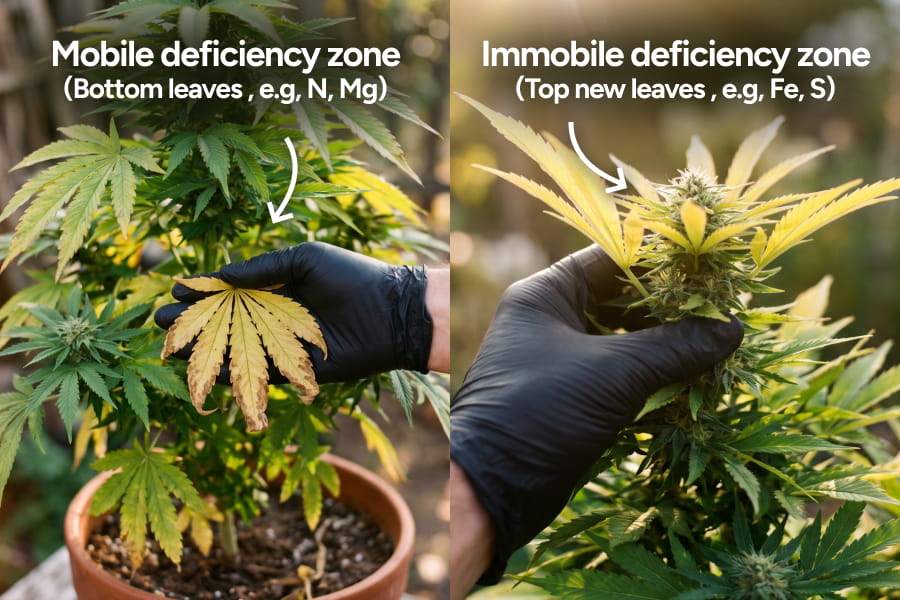
Mobile nutrients move from old growth to new growth, so their deficiencies appear on lower, older leaves first. When a plant runs short of a mobile nutrient, it pulls that element out of its older leaves and sends it to the new growth that needs it most. The old leaves pay the price and show the symptom, while the top of the plant stays green for a while.
Nitrogen, phosphorus, potassium, and magnesium are the mobile nutrients you’ll meet most often. Calcium, sulfur, iron, manganese, and zinc are immobile — the plant cannot relocate them, so a shortage shows up on the newest leaves at the top instead.
This single distinction does most of the diagnostic work: yellowing that starts at the bottom points one direction, and damage that starts at the top points the other.

The Most Common Cannabis Deficiencies by Leaf Symptom
Cannabis growers encounter a predictable set of deficiencies, and each one marks the leaf in a recognizable way. The sections below walk through them in roughly the order they appear in a typical grow, pairing each nutrient with its symptom and its fix. Use the mobile-versus-immobile rule from above to confirm which one you’re looking at.
- Nitrogen — overall pale, oldest leaves yellow and drop first
- Phosphorus — dark dull leaves, purple stems, slow growth
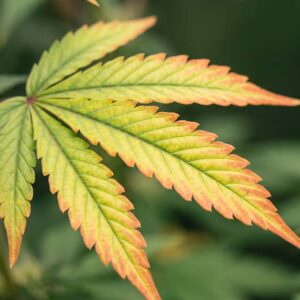
- Potassium — burnt brown edges and tips on lower leaves
- Magnesium — yellowing between the veins on older leaves
- Calcium — hooked, spotted new growth and weak stems
- Iron — bright yellowing between veins on new leaves
- Sulfur — uniform pale color starting on new leaves
- Manganese and zinc — spotting and twisted new growth
Nitrogen (N) Deficiency
Nitrogen deficiency turns the oldest, lowest leaves pale green, then yellow, before they wilt and drop off. Nitrogen is the most mobile major nutrient, so the plant strips it from mature leaves to feed new shoots, which is why the bottom of the plant fades while the top stays green. The yellowing usually spreads evenly across the whole leaf rather than between the veins.
Nitrogen deficiency is normal and expected in late flowering, when the plant naturally moves resources into the buds and sheds fan leaves — that fade is part of ripening, not a problem to fix. During vegetative growth or early flower, though, it signals underfeeding and calls for a richer nitrogen source.
Correct it by raising the strength of a grow-stage nutrient or adding a nitrogen-focused amendment, and confirm the root zone pH is in range so the plant can actually take it up.
Phosphorus (P) Deficiency
Phosphorus deficiency darkens the lower leaves to a dull blue-green, then brings purple or reddish tints to the stems, petioles, and leaf undersides. As it advances, brownish or bronze patches spread across the leaf and the edges curl down. Growth slows, and in flower the plant struggles to build dense buds because phosphorus drives flower development.
Cold root zones make phosphorus harder to absorb, with uptake becoming restricted around 50–59°F (10–15°C). Keeping the root zone warmer helps the plant access the phosphorus already available.
Correct a true shortage with a phosphorus-rich input such as bat guano, bone meal, or a bloom-stage nutrient, and add it gradually, since overcorrecting phosphorus can block other nutrients and trade one problem for another.
Potassium (K) Deficiency
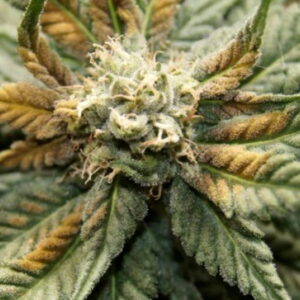
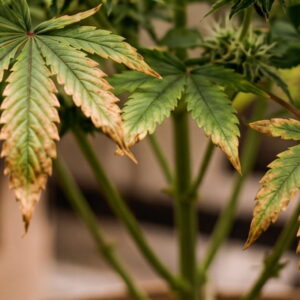
Potassium deficiency usually starts on older, lower leaves, with tips and edges turning tan or brown while the veins stay green. As it progresses, expect dry, scorched margins, necrotic spots, red or yellow mottling between the veins, and sometimes red stems or petioles.
Because potassium governs water movement and bud weight, a flowering plant short on it produces lighter, looser flowers.
More often than not, the plant simply isn’t getting enough potassium. Organic inputs like guano and fish emulsion can run relatively light on potassium compared with nitrogen and phosphorus. If the feed schedule looks adequate, check whether excess calcium, ammonium, or sodium could be interfering with uptake.
Low, acidic pH is another possible cause of potassium lockout, but it’s usually a secondary suspect rather than the starting point. Check the nutrient balance first, then rule out pH and competing elements before adding more potassium.
Magnesium (Mg) Deficiency
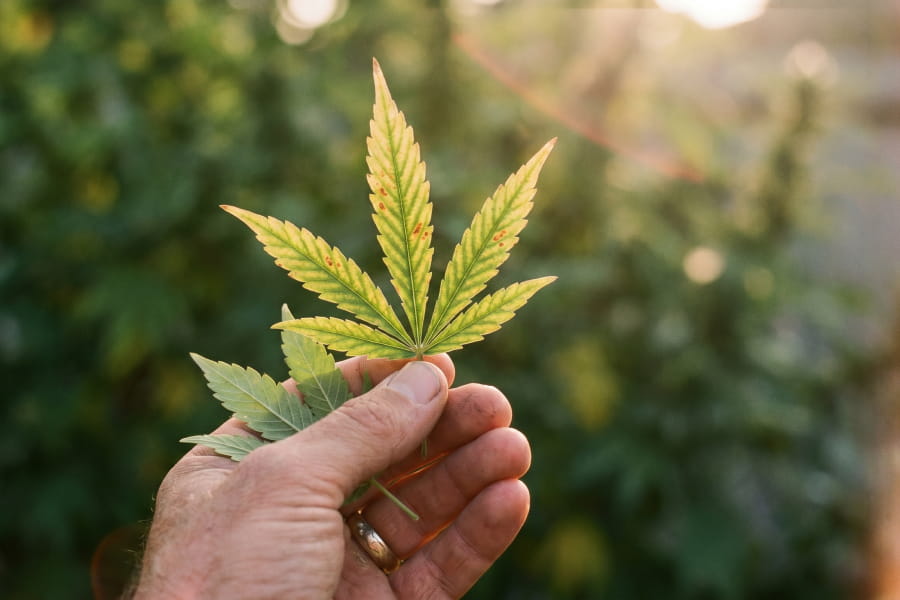
Magnesium deficiency yellows the tissue between the veins on older leaves while the veins themselves stay green, a pattern called interveinal chlorosis. As the deficiency progresses, the yellowed areas can develop brown spots and crispy edges, and the symptoms climb from the lower leaves upward.
Magnesium sits at the center of every chlorophyll molecule, so a shortage directly cuts the plant’s ability to photosynthesize.
Magnesium deficiency is common in soil grows and corrects easily with magnesium sulfate (Epsom salts). Taper the magnesium dose once new growth comes in green. If pH lockout is the cause, flush the medium first to reset the root zone, then correct it and hold your pH in range going forward.
Calcium (Ca) Deficiency
Calcium deficiency damages the newest growth first, leaving hooked or curled leaf tips, small brown spots, and weak, floppy stems. Calcium is immobile, so the plant cannot move it to where it’s needed and the symptom shows up on fresh shoots rather than old leaves. Calcium and magnesium shortages often appear together, especially in coco coir and soft-water grows.
A combined calcium-magnesium supplement (often sold as “Cal-Mag”) resolves most cases and is a routine addition for growers using coco or reverse-osmosis water. As with the others, confirm pH first, since calcium uptake falls off when the root zone drifts too acidic.
Iron (Fe) Deficiency
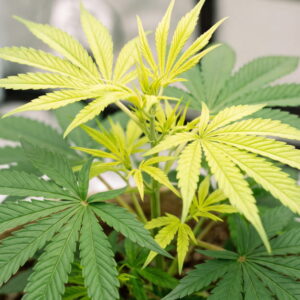
Iron deficiency brightens the new top growth to a vivid yellow between the veins while the veins stay green. It resembles a magnesium shortage but appears on the newest leaves rather than the oldest, because iron is immobile and cannot be relocated. In severe cases the youngest leaves turn almost white.
Iron deficiency is usually a pH problem rather than a true shortage — a high root-zone pH locks iron out even when it’s present in the medium. Bring soil pH into the 5.5 to 6.5 range. A flush can help reset the root zone first if pH has drifted a long way off.
New growth typically greens back up within a week. Add a foliar iron supplement only if pH correction alone doesn’t resolve it.
Sulfur (S) Deficiency
Sulfur deficiency pales the whole leaf to a uniform light green or yellow, starting with the newest growth at the top. It looks much like a nitrogen shortage, but nitrogen fades the old lower leaves first while sulfur fades the new upper ones — leaf position separates the two. The yellowing is even across the leaf rather than concentrated between the veins.
Sulfur deficiency is uncommon and corrects readily with magnesium sulfate (Epsom salts), which delivers both sulfur and magnesium. A sulfur-bearing fertilizer works as well; either way, add it at modest strength and recheck the new growth over the following week.
Manganese and Zinc (Mn / Zn) Deficiencies
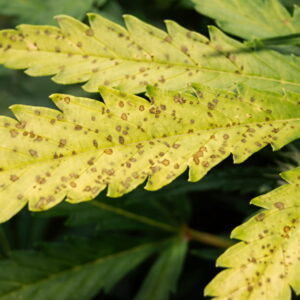
Manganese and zinc deficiencies strike the new growth with mottled spotting, yellowing, and — in the case of zinc — twisted, stunted leaves with shortened spacing between nodes. Both are immobile micronutrients used in small amounts, so shortages are rare and usually tied to high pH rather than a real absence in the feed.
Manganese spotting tends to spread outward from the base of the leaf, while zinc distorts the shape of fresh growth.
Both micronutrient problems usually clear once the root-zone pH is brought back into range, because the elements are typically present but locked out. A balanced micronutrient supplement covers the rare true shortage. Avoid over-applying manganese since excess manganese interferes with iron uptake.
What Nutrient Deficiency Causes Purple Leaves?
Purple cannabis leaves most often signal a phosphorus deficiency, though cold temperatures and genetics produce the same coloring. A phosphorus shortage brings purple or red tints to the stems, petioles, and leaf undersides, usually alongside dark, dull foliage and slowed growth.
If those companion symptoms are absent, the purple is probably not a deficiency at all.
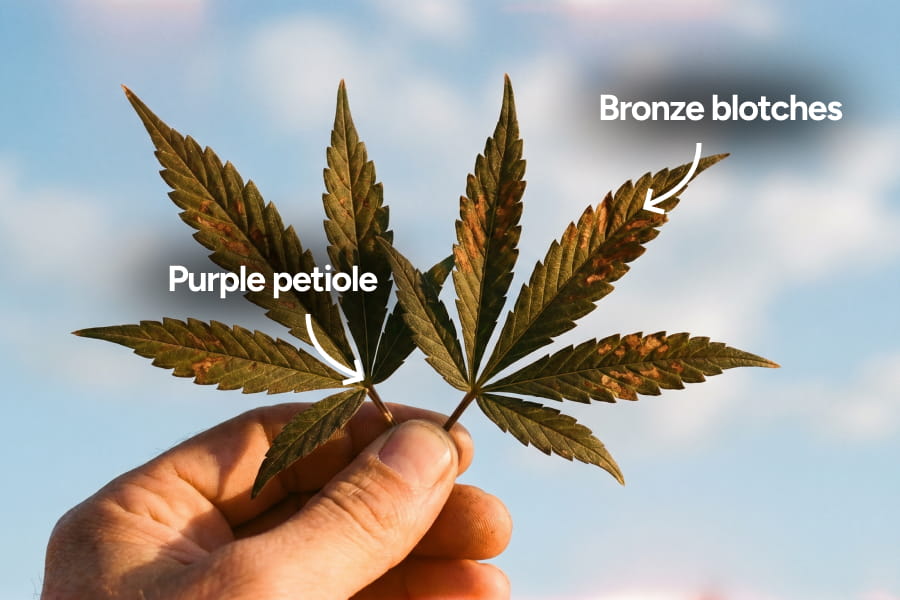
Cool night temperatures can turn stems and leaves purple in plants that are perfectly healthy, since some strains are simply bred to express purple and red pigments as they mature.
Before treating purple leaves as a deficiency, check whether the plant is also growing slowly and darkening — those signs confirm phosphorus — and rule out a naturally colorful genetic line.
Drooping, Curling, and Clawing Leaves: Deficiency or Something Else?
Drooping and curling leaves usually point to a watering or environment problem before they point to a nutrient deficiency. Overwatering is the most common cause of droopy leaves — the leaves sag and feel firm, and the soil stays wet too long between waterings. Underwatering produces a similar droop, but the leaves feel thin and papery and the pot is light.
Leaves that curl or “claw” downward often signal too much nitrogen or heat stress rather than a shortage of anything. Tightly curling leaf edges combined with low humidity can also reflect environmental strain, since dry air and high light push the plant to conserve water.
Swings in temperature and humidity drive many of these symptoms, so for anyone learning how to grow autoflowers outdoors, the environment is the first thing to check before adjusting feed. Confirm watering habits and grow-space conditions first; if those are dialed in and the droop persists, then work back through the deficiency chart.
Nutrient Burn vs Deficiency: How to Tell the Difference
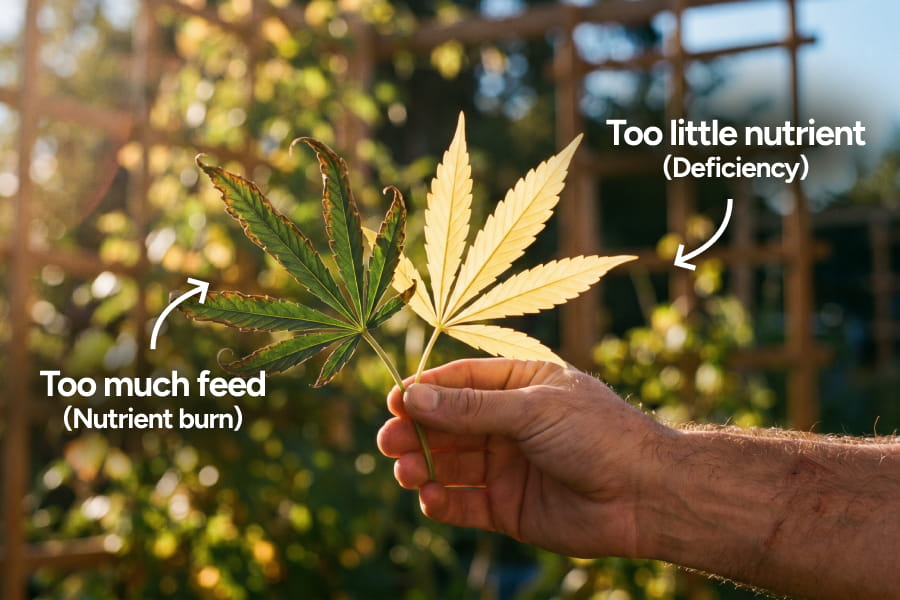
Nutrient burn and deficiency both damage leaf tips, but they come from opposite causes — too much feed versus too little — so the fix runs in opposite directions. Nutrient burn shows as bright, solid brown or yellow tips on healthy, deep-green leaves, often with a slightly clawed or glossy look from overfeeding.
A deficiency, by contrast, pairs leaf damage with overall fading, paling, or interveinal yellowing as the plant runs short.
The practical test is the rest of the leaf. If the tips are scorched but the leaf is otherwise dark and vigorous, you’re overfeeding and should flush and cut back nutrients. If the tips are damaged and the leaf is also losing color or yellowing, you’re underfeeding or facing a lockout and should correct pH first, then feed.
Potassium deficiency is the one most often confused with nutrient burn because both scorch leaf tips and edges. The tell is what’s happening between the veins and lower on the plant: potassium loss shows mottled red and yellow patches between veins that stay green, plus red stems and petioles — symptoms that nutrient burn doesn’t produce. It also starts on the older, lower leaves rather than hitting healthy growth across the plant the way burn does.
What Causes Deficiencies? pH Lockout and Overfeeding
Most cannabis deficiencies come from a root-zone pH that locks nutrients out, not from nutrients missing in the feed. Each nutrient has a pH band where roots can absorb it, and when the medium drifts outside that band, the element stays in the soil but becomes unavailable to the plant.
This is why a grower feeding a complete nutrient can still watch a plant starve: the food is there, but the roots can’t reach it.
Soil takes up nutrients best at 5.5 to 6.5 (ideal 6.0 to 6.3), while hydro and coco run slightly more acidic at 5.6 to 6.4 (ideal 5.8 to 6.2). Let soil climb toward 7.0 and iron, manganese, and zinc start to lock out. Overfeeding causes the opposite problem: too much of one nutrient blocks another, which is how heavy nitrogen or calcium triggers a potassium shortage.
A plant can carry several deficiencies at once, usually because a pH swing has locked out multiple elements together. Checking pH is the first move for almost every deficiency, and it often fixes the symptom without adding anything.
How to Fix and Prevent Cannabis Deficiencies
Fixing a cannabis deficiency follows a consistent sequence: identify the symptom, check the pH, correct the cause, then watch the new growth. Old damaged leaves rarely recover, so the signal that a fix is working is healthy new growth coming in green, not the old leaves turning around. Move in small steps, because overcorrecting a deficiency commonly creates the next one.
The reliable prevention routine is steady and unglamorous: feed a balanced nutrient matched to your growing stage and medium, measure pH at every watering, and keep the root zone in its target band.
Quality cannabis fertilizers designed for each grow stage make this easier by supplying the right ratios at the right time, which heads off most shortages before they mark a leaf. Where local law permits cultivation, a consistent feeding and pH schedule prevents far more deficiencies than any single corrective treatment fixes.
Healthy Plants Start with Strong Genetics
Healthy cannabis plants resist deficiencies better when they begin with vigorous, stable genetics. A robust plant takes up nutrients more efficiently and shrugs off minor pH swings that would mark a weaker one, which makes seed selection the quiet first step in deficiency prevention.
Strong genetics don’t replace good feeding and pH management, but they widen the margin for error while a grower learns to read the leaves.
Growers building a resilient garden often start with feminized seeds for predictable, all-female crops. You can also buy cannabis seeds from a broad selection of stable, vigorous cultivars suited to different growing styles. For growers who want a shorter, hardier lifecycle, buying autoflower seeds offers fast, forgiving plants well suited to first-time troubleshooting.
Pairing strong genetics with the fundamentals in this guide is the most direct route to plants that rarely show a deficiency in the first place.
Frequently Asked Questions
Can a Cannabis Plant Have More Than One Deficiency at Once?
Yes. A plant can show several deficiencies at once, most often because a root-zone pH problem has locked out multiple nutrients. Correcting pH frequently resolves several symptoms at once, which is why it’s the first step before adding any single nutrient.
How Do I Know If It’s a Deficiency or Nutrient Burn?
Check the whole leaf, not just the tip. Nutrient burn scorches the tips of otherwise deep-green, healthy leaves and means you’re overfeeding. A deficiency pairs leaf damage with overall fading or yellowing and means you’re underfeeding or facing a lockout, so flush and cut back for burn, but correct pH and feed for a deficiency.
What Deficiency Makes Cannabis Leaves Turn Purple?
Phosphorus deficiency is the usual nutrient cause of purple leaves, typically alongside dark foliage and slow growth. Cold temperatures and naturally purple strains produce the same color without any deficiency, so confirm the companion symptoms before treating it.
Will Damaged Leaves Recover After I Fix the Deficiency?
Usually not. Leaves already marked by a deficiency rarely return to green, and that’s normal. The sign that your fix is working is fresh new growth coming in healthy — so judge recovery by the new leaves, not the old ones.
Why Do Deficiencies Appear Even When I’m Feeding Nutrients?
Because a deficiency is about uptake, not just supply. When root-zone pH drifts out of range, nutrients stay in the medium but become unavailable to the roots, so the plant starves with food all around it. Measuring and correcting pH at every watering keeps the nutrients you’re already feeding reachable.

Hi. Brand new to the forum. We have been growing successfully for a few years in outdoor unheated greenhouse in MI. Wanted to thank you for e-books. Can’t find my problem though! Will fill out ticket. Looking forward to exploring site.
Hi, Robert, What do in the case of Phosphorous & Zinc deficiency?
Is it possible to have a couple of these deficiencies at the same time? I have some leaves that look like there is Potassium deficiency mixed with Phosphorus deficiency. I just want to know because I know there is a problem and I am positive it is due to nutrients.
Chief Green Leaf,
Yes, you can have more than 1 mineral deficiency in your plant. Generally this would be due to PH being ofrf, probably too high or “alkaline”; Or, too high a level of Nitrogen or Calcium. Both issues could “lock out” or make certain minerals unavailable to the plant.
Join us at: ilovegrowingmarijuana.nl and our members and staff will be happy to provide some guidance. Peace
do you know where I could buy a full size color chart like the one above for nutrient deficiencies ? Thank you
Jim Bell,
You can buy these off Amazon or from any Hydro Store for the most part 🙂
jim bell,
I would look on Amazon. Good Luck. I wish I could give you a link. 🙂
Having a problem using Esomia liquid nuits. Are you familar with this product and can you provide a feeding schedule that will work for me?
poster of leaf dificiency where aviable